
 By
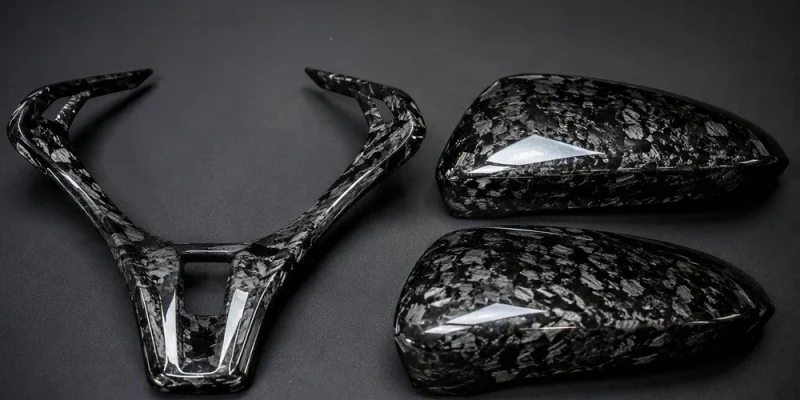
The pattern that started in a Lamborghini lab.
Every material in the supercar world has an origin story, and forged carbon’s is unusually specific: a partnership between Lamborghini and a golf equipment company, a concept car that weighed less than a city hatchback, and a bet that chopped fiber could do what woven cloth could not. Fifteen years later, the bet has reshaped what performance cars look like. Here is how it happened.
The Problem With Cloth
By the mid-2000s, Lamborghini had fully embraced carbon fiber. The material was light, strong, and glamorous. But woven carbon has stubborn limits. Complex three-dimensional shapes fight fabric draping. Hand layup is slow and expensive. And weaving fiber into cloth only to cut it into patterns wastes material and time. For a company that wanted to put carbon everywhere, not just in panels but in structural components with complicated geometry, the cloth was becoming the bottleneck. Anyone who has studied the carbon fiber fabrication process will recognize the constraint: the layup stage is where labor, time, and geometry all collide.
The Unlikely Partner
The solution arrived from golf. Callaway, the golf equipment maker, had been working on compression-molded chopped carbon fiber for club heads. A process that shaped carbon composite quickly, at volume, into complex forms. Around 2008, Lamborghini and Callaway formalized a partnership to develop the technology for cars. The golf world’s loss was the car world’s gain, and the collaboration produced what Lamborghini trademarked as Forged Composite: chopped carbon fiber, resin, pressure, heat, minutes instead of hours.
The Car That Proved It
The proof arrived in 2010 wearing the name Sesto Elemento, the sixth element, carbon itself. The concept car used forged composite extensively, including in structural components, and weighed 999 kilograms. It was a rolling argument: chopped fiber was not a cheaper imitation of woven carbon but a different capability. Shapes and structures that weaving could not produce at any price. The forged carbon story continues into how the material spread from that concept to production.
Why the Bet Paid Off
Forged carbon solved three problems at once. Geometry: the compression-molded compound filled complex molds that fabric could not drape. Speed: cycle times dropped from hours to minutes, making carbon viable at higher volumes. And identity: the marbled pattern was instantly recognizable and impossible to fake convincingly, giving Lamborghini a visual signature no competitor could copy without copying the process itself. Materials that solve engineering problems get adopted. Materials that also create a look become famous.
From Concept to Production Line
The Sesto Elemento was a concept, but the process was not a stunt. Lamborghini moved forged composite into production trim and components through the following decade, and, more importantly, published and patented its way into an industry standard. Other manufacturers licensed, imitated, or independently developed their own chopped-fiber compression processes. Within ten years of the concept car, the marble pattern had spread across supercar interiors, engine covers, and structural pieces from multiple brands. The technology transfer worked exactly as intended: prove it at the exotic end, then let the process economics pull it downward.
What Callaway Got Out of It
The golf side of the partnership is usually told as a punchline, but it deserves respect. Callaway brought years of high-volume compression-molding experience, cycle times, tooling life, charge consistency, that the low-volume car world had never needed to learn. In exchange, the partnership put a golf company inside a supercar program. Cross-industry technology transfer rarely looks this clean: one side had the process, the other had the problem, and neither could have produced forged carbon alone. It is a model worth remembering the next time a car material debuts in a sport you do not follow.
The Spread Beyond Sant’Agata
What starts in a Lamborghini lab never stays there. Forged carbon spread through the Volkswagen Group’s performance brands, then across the supercar industry, then outward into the aftermarket. And then escaped cars entirely into watches, bicycles, and luggage. Each step followed the same logic as the original bet: wherever the shape was complex, the volume meaningful, or the look valuable, chopped fiber found work that woven cloth could not do.
The Lessons of the Origin Story
- Material innovation often arrives from outside the industry, the answer came from golf.
- The process and the aesthetic were invented together; the marble look is the process, made visible.
- Uniqueness as a manufacturing side effect is a marketing gift money cannot plan.
- Bets on process capability, not fashion, are the ones that age well.
There is a quieter legacy too: the partnership normalized the idea that car materials can come from anywhere. After golf clubs came watchmaking, aerospace spinoffs, and consumer electronics. The cross-industry pipeline that the work demonstrated is now standard practice. The next strange material in your car may already be on a tennis court.
Lamborghini did not set out to invent a fashion. It set out to make shapes woven carbon could not make, at speeds hand layup could not match. The marble pattern was a side effect. That the side effect now defines an era of supercar design is the kind of accident only real engineering produces.







Comments